Apple’s iPhone lineup is always at the forefront of technological innovation, and with the release of the iPhone 16 Pro, the company continues to push the boundaries of smartphone technology. The iPhone 15 Pro was already a powerhouse in its own right, but the iPhone 16 Pro brings even more advanced features and improvements.
This in-depth comparison will help you understand the key differences between the iPhone 16 Pro and iPhone 15 Pro, allowing you to decide whether it’s worth upgrading or if the iPhone 15 Pro still holds strong in the competition.
Table of Contents:
- Introduction
- Design and Build
- Display and Screen Technology
- Performance and Processor
- Battery Life and Charging Capabilities
- Camera System and Features
- Software and iOS
- Storage and Memory Options
- Connectivity: 5G, Wi-Fi, and More
- Biometrics and Security
- Durability and Water Resistance
- Audio and Sound Quality
- Environmental Impact and Sustainability
- Pricing and Value for Money
- Conclusion: Which iPhone is Right for You?
1. Introduction
The iPhone 16 Pro represents the latest in Apple’s flagship smartphone line, following the iPhone 15 Pro, which was widely acclaimed for its performance, design, and features. Both devices offer top-tier performance and are aimed at users who want the best Apple has to offer. However, with each new generation, Apple makes improvements in various areas such as the display, processing power, camera quality, and overall user experience.
In this post, we’ll break down the key differences between the iPhone 16 Pro and the iPhone 15 Pro, helping you decide whether upgrading is the right choice for you.
2. Design and Build
iPhone 16 Pro:
The iPhone 16 Pro introduces a more refined design compared to its predecessor. The device features a sleeker and more streamlined body, with even slimmer bezels, providing a more immersive screen experience. The back is crafted from ceramic shield glass for added durability, and the frame is made from aerospace-grade titanium, which is lighter and stronger than the stainless steel frame used in previous models.
New color options like Midnight Blue and Platinum have been introduced, giving the iPhone 16 Pro a modern and luxurious appearance.
iPhone 15 Pro:
The iPhone 15 Pro also features a high-end design with a stainless steel frame and a ceramic shield front cover, providing excellent durability. While it maintains the same general design language as the iPhone 16 Pro, it is slightly bulkier due to the stainless steel frame, and the bezels are a little thicker, though not by much.
Color options for the iPhone 15 Pro include Graphite, Silver, and Gold.
Key Difference: The iPhone 16 Pro is lighter, sleeker, and features an aerospace-grade titanium frame for added durability, while the iPhone 15 Pro sticks to the traditional stainless steel design.
3. Display and Screen Technology
iPhone 16 Pro:
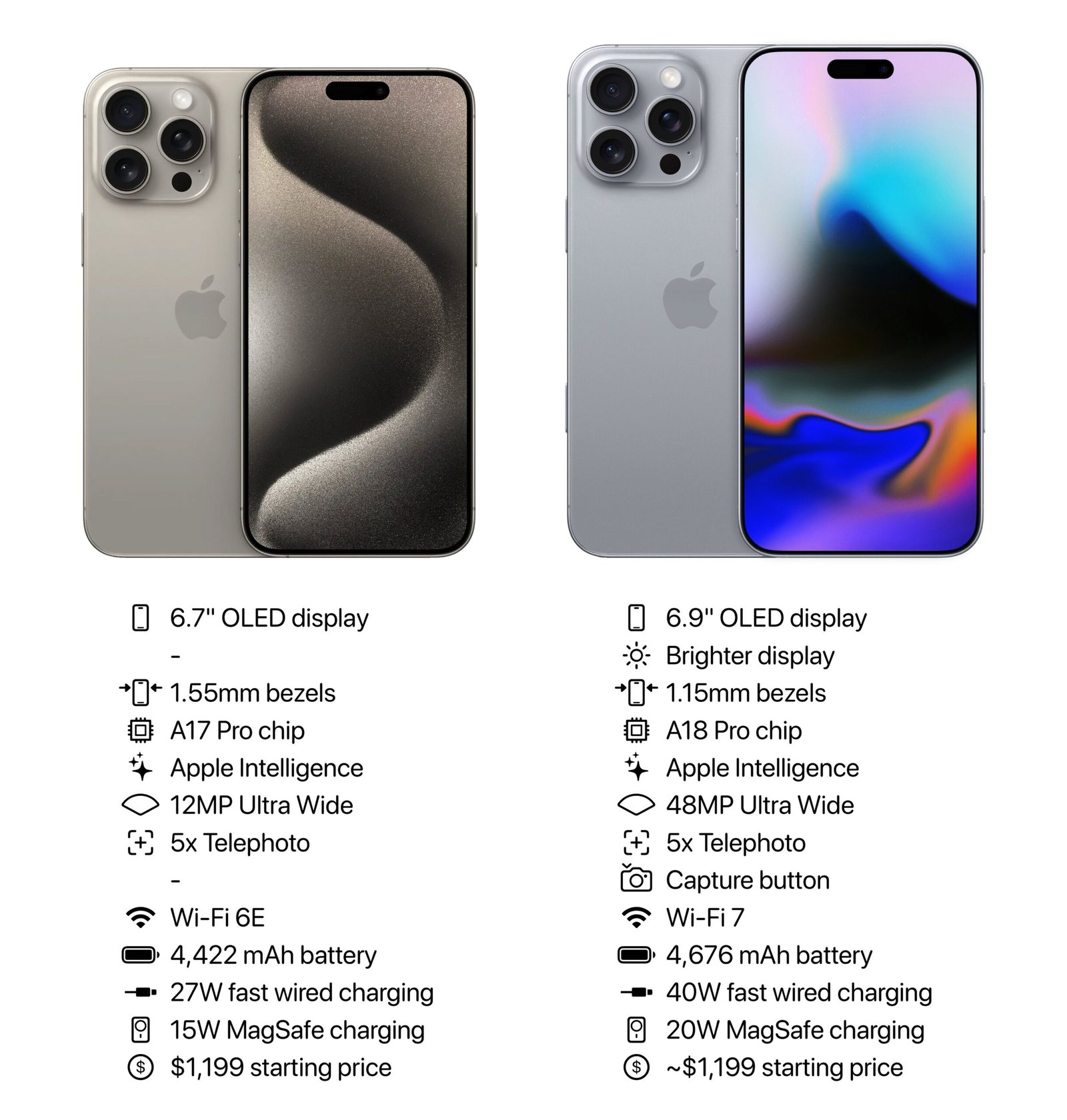
The iPhone 16 Pro comes with a 6.1-inch Super Retina XDR OLED display, featuring a 120Hz ProMotion refresh rate, providing a smoother experience when scrolling, gaming, and watching videos. The display also supports HDR10 and Dolby Vision, with a peak brightness of 2,200 nits, making it easier to view in bright sunlight. Additionally, Apple has introduced a new Always-On display feature that is more energy-efficient than previous versions.
iPhone 15 Pro:
The iPhone 15 Pro also sports a 6.1-inch Super Retina XDR OLED display with a 120Hz refresh rate, supporting HDR10 and Dolby Vision. However, the peak brightness is slightly lower at 1,600 nits, making it less effective in direct sunlight compared to the iPhone 16 Pro.
Key Difference: The iPhone 16 Pro offers a brighter display and a more power-efficient Always-On feature, while the iPhone 15 Pro still delivers excellent display quality but lacks some of these enhancements.
4. Performance and Processor
iPhone 16 Pro:
At the heart of the iPhone 16 Pro is Apple’s new A17 Pro chip, which boasts a 6-core CPU and a 5-core GPU. The A17 Pro offers a significant performance boost compared to the A16 Bionic chip found in the iPhone 15 Pro. According to Apple, the A17 Pro chip provides up to 25% faster CPU performance and 30% better graphics performance. This is particularly noticeable when gaming, editing videos, or using augmented reality (AR) applications.
iPhone 15 Pro:
The iPhone 15 Pro is powered by the A16 Bionic chip, which is no slouch when it comes to performance. While it delivers excellent processing power for gaming, multitasking, and content creation, it falls slightly short when compared to the A17 Pro in the iPhone 16 Pro.
Key Difference: The iPhone 16 Pro’s A17 Pro chip offers a significant performance upgrade, especially in demanding tasks such as gaming and video editing, compared to the A16 Bionic chip in the iPhone 15 Pro.
5. Battery Life and Charging Capabilities
iPhone 16 Pro:
Apple has increased the battery life on the iPhone 16 Pro, offering up to 24 hours of video playback and up to 20 hours of internet use. The iPhone 16 Pro also features fast charging capabilities, allowing it to charge up to 50% in just 25 minutes with Apple’s 35W fast charger. Additionally, the iPhone 16 Pro supports reverse wireless charging, enabling users to charge their AirPods or Apple Watch directly from the phone.
iPhone 15 Pro:
The iPhone 15 Pro offers slightly less battery life, with up to 22 hours of video playback and up to 18 hours of internet use. It also supports fast charging but maxes out at 30W, so it takes a bit longer to reach 50%. The iPhone 15 Pro does not support reverse wireless charging.
Key Difference: The iPhone 16 Pro provides slightly better battery life, faster charging, and the added benefit of reverse wireless charging, making it more versatile than the iPhone 15 Pro.
6. Camera System and Features
iPhone 16 Pro:
The iPhone 16 Pro features a triple-camera system with a 48MP main sensor, a 12MP ultra-wide lens, and a 12MP telephoto lens with 5x optical zoom. Apple has made significant improvements in the camera software, with enhanced Smart HDR 5, better low-light performance, and the introduction of a new AI-based image stabilization system. The front-facing camera also sees upgrades with 4K cinematic mode and improved portrait capabilities.
iPhone 15 Pro:
The iPhone 15 Pro also features a triple-camera system but with a 12MP main sensor. While it still delivers excellent photo and video quality, particularly with Apple’s computational photography and Night Mode, the iPhone 16 Pro offers superior performance in low-light conditions and better zoom capabilities.
Key Difference: The iPhone 16 Pro’s 48MP main camera and improved AI features make it a better choice for photography enthusiasts, while the iPhone 15 Pro still holds its own with its 12MP camera system.
7. Software and iOS
Both the iPhone 16 Pro and iPhone 15 Pro run on iOS 17, the latest version of Apple’s operating system. iOS 17 brings new features such as interactive widgets, a revamped Control Center, and enhanced privacy settings. Additionally, the iPhone 16 Pro benefits from exclusive software optimizations tailored to the A17 Pro chip, ensuring a smoother experience.
Key Difference: While both devices run on iOS 17, the iPhone 16 Pro benefits from better optimization, thanks to its A17 Pro chip, leading to faster performance and improved AI-based features.
8. Storage and Memory Options
iPhone 16 Pro:
The iPhone 16 Pro offers three storage options: 256GB, 512GB, and 1TB, providing ample space for users who store a lot of content, including videos, apps, and photos. The 1TB option is ideal for professionals who require large storage capacities.
iPhone 15 Pro:
The iPhone 15 Pro comes with similar storage options: 128GB, 256GB, and 512GB. However, it lacks the 1TB storage option, which may be limiting for heavy users.
Key Difference: The iPhone 16 Pro provides a higher storage option of 1TB, making it a better choice for users who need extensive storage.
9. Connectivity: 5G, Wi-Fi, and More
iPhone 16 Pro:
The iPhone 16 Pro supports 5G, Wi-Fi 6E, and Bluetooth 5.3, offering faster and more reliable connectivity across the board. The addition of Wi-Fi 6E provides better performance on supported networks, particularly in crowded areas.
iPhone 15 Pro:
The iPhone 15 Pro also supports 5G and Bluetooth 5.2 but is limited to Wi-Fi 6. While this still offers excellent connectivity, it’s not as fast or future-proof as Wi-Fi 6E.
Key Difference: The iPhone 16 Pro supports the newer Wi-Fi 6E standard, which offers faster speeds and better performance in congested networks compared to the iPhone 15 Pro’s Wi-Fi 6.
10. Biometrics and Security
Both the iPhone 16 Pro and iPhone 15 Pro feature Face ID for secure authentication. The iPhone 16 Pro, however, introduces an under-display fingerprint sensor as an additional biometric option, providing users with more flexibility.
Key Difference: The iPhone 16 Pro offers an under-display fingerprint sensor, adding an extra layer of biometric security that the iPhone 15 Pro lacks.
11. Durability and Water Resistance
Both the iPhone 16 Pro and iPhone 15 Pro are IP68-rated, meaning they are dustproof and can withstand being submerged in water up to 6 meters deep for 30 minutes. However, the iPhone 16 Pro’s titanium frame gives it an edge in terms of overall durability.
Key Difference: The iPhone 16 Pro’s titanium frame makes it more durable than the iPhone 15 Pro’s stainless steel design.
12. Audio and Sound Quality
iPhone 16 Pro:
The iPhone 16 Pro features Dolby Atmos and spatial audio support, as well as improved stereo speakers. These enhancements provide clearer and more immersive sound quality, particularly in movies and music.
iPhone 15 Pro:
The iPhone 15 Pro also supports Dolby Atmos and spatial audio, but its speaker quality is slightly inferior to the iPhone 16 Pro, with less clarity and bass.
Key Difference: The iPhone 16 Pro offers slightly better audio quality, making it ideal for those who use their phone for media consumption.
13. Environmental Impact and Sustainability
Apple continues to make strides in reducing its environmental impact with both the iPhone 16 Pro and iPhone 15 Pro. The iPhone 16 Pro, however, takes sustainability to the next level by incorporating even more recycled materials and adopting a greener manufacturing process.
Key Difference: The iPhone 16 Pro is more eco-friendly than the iPhone 15 Pro due to its increased use of recycled materials and improved production processes.
14. Pricing and Value for Money
iPhone 16 Pro:
The iPhone 16 Pro is priced at $1,199 for the base 256GB model and can go up to $1,499 for the 1TB version. While it’s a premium price, the added features and future-proofing make it a worthy investment for tech enthusiasts and professionals.
iPhone 15 Pro:
The iPhone 15 Pro starts at a lower price point of $1,099 for the 128GB model, with the highest configuration (512GB) costing $1,399. While it’s more affordable, it lacks some of the advanced features of the iPhone 16 Pro.
Key Difference: The iPhone 16 Pro is more expensive but offers better value for users looking for the latest technology and future-proofing, while the iPhone 15 Pro is a more budget-friendly option.
15. Conclusion: Which iPhone is Right for You?
Ultimately, the decision between the iPhone 16 Pro and iPhone 15 Pro comes down to your personal needs and budget. If you are looking for the latest technology with improved performance, camera capabilities, and future-proofing features, the iPhone 16 Pro is the obvious choice. Its A17 Pro chip, 48MP camera, under-display fingerprint sensor, and Wi-Fi 6E support make it a standout in the smartphone market.
However, if you are content with slightly older technology but still want a top-performing device, the iPhone 15 Pro remains an excellent option, particularly for those looking to save some money.
No matter which iPhone you choose, you’ll be getting a device that offers exceptional performance, a stunning display, and a premium design.